close
Choose Your Site
Global
Social Media
Views: 0 Author: Site Editor Publish Time: 2026-07-01 Origin: Site
Table of Contents
In tissue converting operations, the quality of the Tissue Jumbo Roll plays a decisive role in determining production efficiency, cost control, and final product consistency. Even minor variations in fiber structure, moisture balance, or roll winding quality can significantly impact machine performance during high-speed converting.
For tissue converters, distributors, and private label brands, raw material selection is not only a purchasing decision—it is a core operational factor that directly influences manufacturing stability, waste levels, and long-term profitability.
Understanding how tissue jumbo roll quality affects production costs allows buyers to make more informed sourcing decisions and build a more efficient and reliable supply chain.
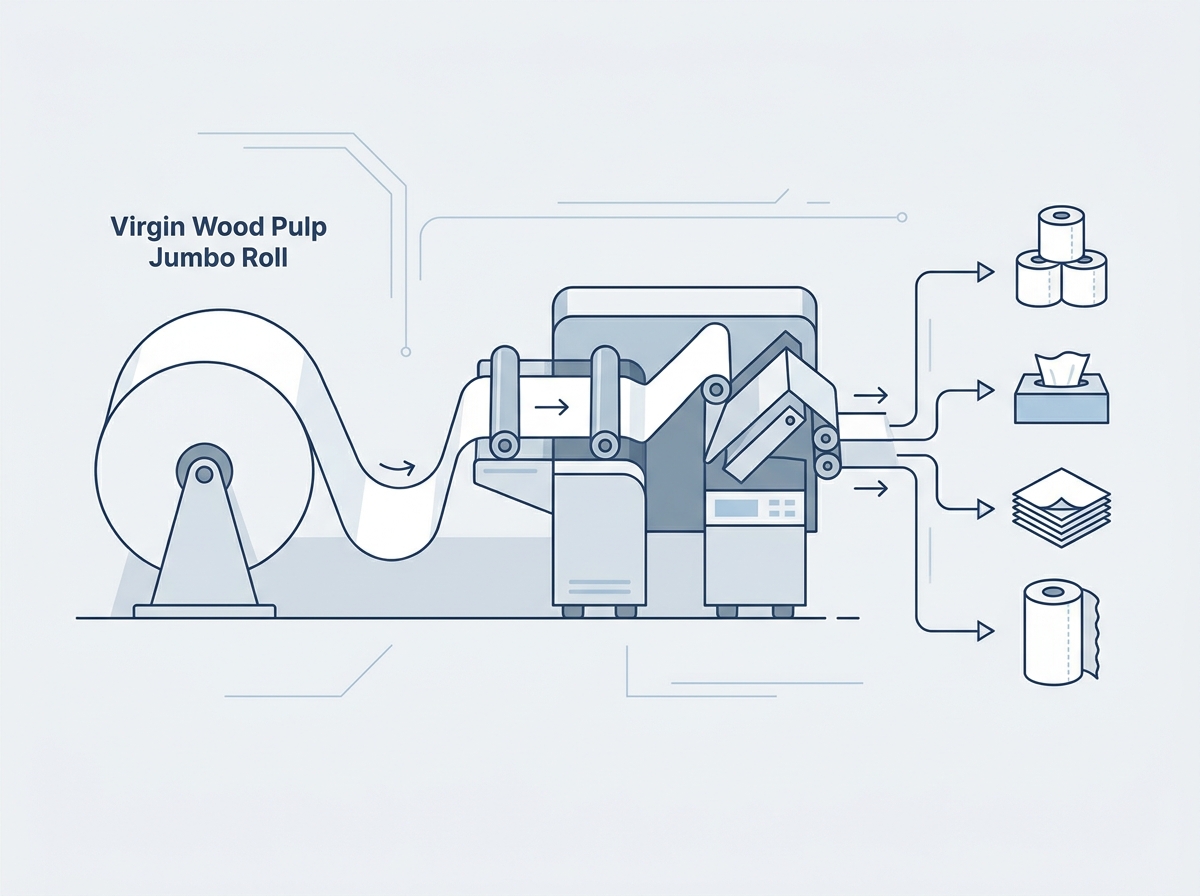
The 1800mm Virgin Wood Pulp Jumbo Roll designed for optimized high-speed tissue converting and manufacturing operations.
Tissue jumbo roll quality directly impacts machine uptime, converting efficiency, and total manufacturing cost
Stable GSM, moisture content, and fiber structure are critical for reducing production interruptions
High-quality tissue base paper significantly reduces waste, downtime, and maintenance frequency
Low-quality jumbo rolls often create hidden costs that exceed initial material savings
Choosing a reliable tissue jumbo roll supplier is essential for long-term production stability and profitability
The Tissue Jumbo Roll is the foundation of all tissue converting operations. Its quality determines not only product consistency but also the stability of the entire production line. In high-speed manufacturing environments, even minor variations in raw paper performance can significantly affect operational efficiency and cost structure.
Instead of looking at tissue base paper as a simple material input, manufacturers evaluate it through three critical performance dimensions:
Performance Area | What It Affects | Business Impact |
|---|---|---|
Machine Stability | Web tension, break frequency | Downtime & efficiency loss |
Material Yield | Waste rate, trim loss | Raw material cost per ton |
Process Consistency | Embossing, perforation accuracy | Product quality variation |
Key Insight:
A small improvement in tissue jumbo roll consistency can create a measurable reduction in total manufacturing cost.
Low-quality tissue jumbo rolls introduce hidden operational risks that accumulate over time:
Frequent web breaks during high-speed converting
Unstable tension during unwinding and rewinding
Inconsistent embossing depth and pattern clarity
Higher dust generation leading to machine contamination
Increased operator intervention and line stoppages
These issues do not appear as direct material costs—but they significantly increase cost per finished unit.
Tissue Jumbo Roll Quality | Machine Downtime | Waste Level | Labor Intervention | Overall Cost Impact |
|---|---|---|---|---|
Premium Quality | Low | Low | Minimal | Optimized Cost Structure |
Standard Quality | Medium | Medium | Occasional Adjustment | Moderate Efficiency Loss |
Low Quality | High | High | Frequent Intervention | Significant Hidden Cost |
Even if low-quality rolls are cheaper at procurement stage, the total production cost is often higher due to inefficiency.
For tissue converters, the real cost driver is not the raw material price—it is machine efficiency per ton of output.
High-quality tissue jumbo rolls allow:
Stable high-speed operation
Lower downtime ratio
Reduced maintenance frequency
More predictable production planning
Higher output consistency per shift
This is why premium base paper is considered a production efficiency enabler, not just a raw material.
Stable input material = stable machine behavior = lower cost per unit
This principle explains why experienced converters prioritize tissue jumbo roll consistency over marginal price differences.
Stable GSM is one of the most critical factors in maintaining consistent converting performance. When the basis weight is uniform across the entire Tissue Jumbo Roll, the paper web behaves predictably during unwinding, embossing, and slitting processes.
Even small GSM fluctuations can lead to tension instability, uneven feeding, and misalignment in downstream converting units, forcing operators to slow down production or make manual adjustments.
GSM Stability Level | Machine Behavior | Production Impact |
|---|---|---|
High Stability | Smooth tension control | Maximum speed operation |
Medium Stability | Occasional adjustment needed | Moderate efficiency loss |
Low Stability | Frequent tension fluctuation | High downtime risk |
Reduces machine tension correction frequency
Improves embossing and slitting accuracy
Supports continuous high-speed operation
Minimizes operator intervention
Key Insight: Stable GSM is not just a quality metric—it directly determines how fast and stable your production line can run.
Web breaks are one of the most costly disruptions in tissue converting because they immediately stop the entire production line. High tensile strength in premium tissue jumbo rolls ensures the paper web can withstand continuous mechanical stress during high-speed processing.
Stronger fiber bonding reduces the risk of rupture, especially under high tension conditions in embossing and rewinding stages.
Material Quality | Break Frequency | Downtime Impact |
|---|---|---|
Premium Strength | Low | Minimal interruption |
Standard Strength | Medium | Occasional stops |
Low Strength | High | Frequent line stoppage |
Reduced machine stoppage time
Lower material waste during re-threading
More stable long-run production cycles
Improved operator efficiency
Key Insight: Every avoided web break directly increases effective production output without changing machine speed.
Moisture content directly influences the physical behavior of tissue paper during converting. If moisture is too low, the paper becomes brittle; if too high, it becomes unstable and difficult to process.
Premium tissue jumbo rolls maintain controlled moisture distribution to ensure consistent performance throughout the entire roll.
Moisture Condition | Material Behavior | Production Result |
|---|---|---|
Optimal | Flexible & stable | Smooth converting |
Too Dry | Brittle, easy to crack | Increased breakage |
Too Moist | Deformation risk | Poor embossing quality |
More stable embossing performance
Improved slitting precision
Reduced deformation during rewinding
Lower reject rate in finished products
Key Insight: Moisture consistency ensures predictable machine behavior across all converting stages.
Roll winding quality determines how smoothly the jumbo roll feeds into the converting line. Poor winding leads to vibration, uneven tension, and instability during unwinding, forcing machines to operate at reduced speeds.
Premium jumbo rolls are tightly and uniformly wound, ensuring smooth and stable feeding throughout the production cycle.
Winding Quality | Machine Stability | Speed Capability |
|---|---|---|
High Quality | Stable | Full speed operation |
Medium Quality | Slight vibration | Reduced speed required |
Poor Quality | Unstable feeding | Frequent slowdowns |
Enables higher machine operating speed
Reduces vibration during unwinding
Improves tension consistency
Minimizes operator corrections
Key Insight: Better winding quality directly translates into higher usable production speed.
Dust generation during converting not only affects machine cleanliness but also impacts long-term equipment reliability. Excessive dust can accumulate on sensors, cutting systems, and moving components, leading to performance degradation.
Premium tissue jumbo rolls significantly reduce dust generation due to better fiber control and surface uniformity.
Dust Level | Machine Condition | Maintenance Requirement |
|---|---|---|
Low | Clean operation | Minimal maintenance |
Medium | Gradual buildup | Regular cleaning required |
High | Sensor interference | Frequent downtime |
Cleaner converting environment
Reduced maintenance frequency
Longer equipment lifespan
Improved sensor and blade accuracy
Key Insight: Lower dust levels reduce hidden maintenance costs that accumulate over time.
Low-quality tissue jumbo rolls may appear cost-effective during procurement, but in real converting operations, they introduce multiple hidden inefficiencies that significantly increase total manufacturing cost. These issues are often not visible at the purchasing stage, but become apparent during continuous production.
The real problem is not the material itself, but the instability it creates throughout the converting process.
Cost Driver | What Happens in Production | Impact on Efficiency |
|---|---|---|
Web Instability | Frequent breaks during converting | Downtime increases |
GSM Variation | Uneven sheet thickness | Higher rejection rate |
Weak Fiber Structure | Poor tensile resistance | Lower machine speed |
Excess Dust | Machine contamination | Maintenance frequency increases |
Poor Winding Quality | Unstable unwinding | Reduced production speed |
In actual manufacturing environments, these problems rarely occur in isolation. Instead, they interact and compound during long production runs.
Web breaks interrupt continuous operation and require machine restart
GSM variation leads to inconsistent embossing and product rejection
Weak fiber structure forces operators to reduce machine speed for safety
Dust accumulation gradually reduces sensor accuracy and cutting precision
Poor winding creates vibration and tension fluctuation during unwinding
Over time, these issues reduce overall equipment effectiveness (OEE), which directly impacts production output per shift.
At first glance, low-quality jumbo rolls reduce procurement cost. However, they increase hidden operational costs that are not reflected in raw material pricing.
Increased machine downtime per production cycle
Higher material waste due to trimming and breakage
More frequent operator intervention
Increased maintenance and cleaning requirements
Lower output per hour of operation
These factors collectively raise the true cost per ton of finished tissue products, even if the initial material price is lower.
Quality Level | Machine Stability | Waste Rate | Maintenance Load | Total Production Cost |
|---|---|---|---|---|
Premium Rolls | High | Low | Low | Optimized |
Standard Rolls | Medium | Medium | Medium | Balanced |
Low-Quality Rolls | Low | High | High | Highest |
In high-efficiency tissue converting operations, procurement decisions are rarely based on unit price alone. Instead, experienced buyers focus on:
Machine uptime rate
Output per shift
Waste percentage
Maintenance cycle frequency
This is why stable tissue jumbo rolls are considered a production efficiency asset rather than a simple raw material.
In industrial tissue converting, the quality of a jumbo roll is not defined by isolated specifications, but by how consistently it performs under continuous production stress. What matters most is whether the material behaves predictably across long production cycles, high-speed operation, and varying environmental conditions.
A truly high-quality tissue jumbo roll is one that minimizes variability while maintaining stable converting performance from start to finish.
The choice of fiber source fundamentally determines how the paper behaves during converting. Virgin wood pulp provides a more uniform fiber structure, which helps maintain stability under tension and reduces the risk of unexpected breakage during high-speed operation.
In practice, this directly affects how smoothly the machine can run without requiring speed adjustments or operator intervention.
GSM stability is one of the most critical indicators of process reliability. Even small fluctuations in basis weight can lead to uneven tension distribution, which affects embossing accuracy and rewinding stability.
Consistent GSM ensures that every meter of the roll behaves the same during converting, which is essential for high-speed production environments.
Roll width, diameter, and core stability are not just packaging parameters—they directly influence machine compatibility and unwinding behavior.
Inconsistent dimensions often lead to alignment issues, vibration, or unnecessary machine adjustments during production setup.
Moisture content determines how the fiber responds to mechanical stress. If the paper is too dry, it becomes brittle and prone to cracking. If it is too moist, it loses structural stability during converting.
A controlled moisture level ensures that the material remains flexible enough for processing while still maintaining strength under tension.
Uniform fiber distribution ensures that stress is evenly distributed across the paper web during converting. When fiber structure is inconsistent, weak points form in the roll, increasing the likelihood of breaks or defects.
Stable fiber uniformity improves not only machine performance but also final product consistency.
Winding quality is often underestimated, but it directly affects unwinding behavior. Poorly wound rolls create tension fluctuations, vibration, and instability during high-speed operation.
A well-wound jumbo roll ensures smooth unwinding, which supports higher production speeds and reduces mechanical stress on the equipment.
In tissue jumbo roll production, performance stability is not determined by isolated machine features, but by how effectively the manufacturing process controls small variations in fiber structure, moisture, and roll formation. These controlled variables directly influence how the material behaves during high-speed converting.
Instead of viewing manufacturing features as separate technologies, they should be understood as control points that reduce variability across the production system.
GSM control reduces thickness fluctuation, ensuring stable tension during converting
Fiber structure optimization improves stress distribution, reducing weak-point breakage
Moisture regulation stabilizes material flexibility, preventing brittleness or deformation
Precision winding ensures consistent roll behavior, avoiding vibration during unwinding
Dust control improves machine reliability, reducing long-term sensor and blade interference
Control Factor | What It Improves | Production Result |
|---|---|---|
GSM Stability | Thickness uniformity | Stable machine speed |
Fiber Structure | Mechanical strength | Reduced breakage risk |
Moisture Balance | Material flexibility | Smoother converting |
Winding Precision | Roll behavior | Higher operational stability |
Dust Control | Equipment condition | Lower maintenance load |
These manufacturing features do not independently increase production efficiency. Their real value comes from reducing variability, which allows the entire converting line to operate closer to its designed performance level with fewer interruptions.
Different tissue products place very different demands on the base paper used in converting. In real production environments, there is no single “universal” tissue jumbo roll that performs optimally across all applications. Instead, material selection is always aligned with the final product’s functional requirements and converting behavior.
This is why experienced converters evaluate tissue base paper based on end-use performance rather than only technical specifications.
Finished Product | Primary Performance Requirement | Recommended Tissue Jumbo Roll Type |
|---|---|---|
Toilet Paper | Softness + comfort | Balanced virgin pulp roll |
Facial Tissue | Surface softness + cleanliness | High-quality virgin fiber roll |
Kitchen Towels | Wet strength + durability | High-strength softwood blend |
Napkins | Embossing + appearance | Medium GSM virgin / mixed fiber |
Hand Towels | Absorbency + toughness | Recycled or reinforced blend |
Even if two tissue jumbo rolls share similar specifications, their performance can differ significantly when used in different converting applications.
Facial tissue is highly sensitive to dust and fiber uniformity
Kitchen towels require structural strength under wet conditions
Napkins depend heavily on embossing response and sheet stability
Toilet paper requires balance between softness and tensile strength
This means mismatched material selection often leads to instability in converting, increased waste, and inconsistent finished product quality.
In industrial tissue production, selection is not based on “best material overall”, but on “best material for the application”.
This is why converters typically align jumbo roll specifications with:
Machine type and converting speed
End-user expectations in target markets
Required balance between softness, strength, and absorbency
Selecting a tissue jumbo roll supplier is not only a sourcing decision—it is a long-term production risk decision. In continuous converting operations, supplier consistency directly affects machine stability, production efficiency, and overall manufacturing cost.
A reliable supplier is not defined by price or specifications alone, but by their ability to deliver consistent quality over long production cycles.
Evaluation Factor | What to Check | Production Impact |
|---|---|---|
Raw Material Stability | Fiber consistency across batches | Stable converting performance |
Production Capability | Equipment & process control | Output consistency |
Quality Control System | GSM, moisture, tensile testing | Reduced production variation |
Customization Ability | GSM, width, diameter flexibility | Machine compatibility |
Export Experience | Logistics & documentation handling | Supply chain reliability |
Even when specifications look identical on paper, supplier capability differences can create significant production variation.
Inconsistent GSM between batches affects machine stability
Poor moisture control leads to converting instability
Weak quality control increases defect rate in finished products
Limited customization reduces machine efficiency
Unstable supply disrupts production planning
These risks often become visible only during continuous production, not during initial sampling.
In real procurement environments, experienced tissue converters rarely choose suppliers based on unit price alone. Instead, they evaluate long-term production stability.
Key decision factors include:
Batch-to-batch consistency
Machine compatibility across production lines
Long-term supply reliability
Technical support capability
Overall cost per ton of finished output
This approach prioritizes production stability over short-term savings.
A reliable tissue jumbo roll supplier is essentially a production stability partner. Their role is not limited to material delivery, but extends to ensuring that the converting process remains efficient, predictable, and cost-controlled over time.
In tissue converting operations, manufacturing cost increases are often not caused by a single factor, but by repeated procurement and material selection mistakes. These mistakes typically do not appear immediately at the purchasing stage, but gradually accumulate during continuous production, affecting efficiency, waste levels, and machine stability.
Focusing only on the lowest procurement price often ignores how the material behaves during high-speed converting. A cheaper tissue jumbo roll may appear cost-effective initially, but unstable performance usually leads to higher waste, more downtime, and increased operator intervention.
In many cases, the lowest purchase price results in the highest total production cost.
Tissue converting lines operate under specific mechanical conditions such as tension control, speed range, and embossing pressure. If the tissue jumbo roll is not compatible with the machine setup, operators are forced to reduce production speed or adjust parameters frequently.
This reduces overall equipment efficiency and limits output capacity.
GSM inconsistency is one of the most common hidden causes of production instability. When basis weight fluctuates across the roll, the material behaves unpredictably during unwinding and converting.
This often results in uneven embossing, unstable tension, and increased rejection rates.
Different tissue products require different fiber characteristics. Using inappropriate fiber types can lead to weak tensile strength, poor absorbency, or unstable converting performance.
Over time, this mismatch increases breakage frequency and reduces production efficiency.
A supplier’s ability to maintain consistent quality over time is often more important than initial sample performance. Inconsistent batch quality can disrupt production planning and increase hidden operational costs.
Stable supply ensures predictable production cycles and reduces long-term risk.
Tissue jumbo roll quality directly determines how stable and efficient a converting operation can run. Across high-speed production environments, even small inconsistencies in GSM, fiber structure, moisture balance, or winding quality can accumulate into significant operational inefficiencies.
What often appears as minor material variation at the procurement stage becomes amplified during continuous production, affecting downtime, waste levels, and overall output consistency.
Procurement Insight
In real purchasing decisions, the key differentiation between suppliers is not unit price or specification sheets, but long-term production stability.
A reliable tissue jumbo roll supplier is not just a material provider—it is a stability factor in the entire manufacturing system.
Final Business Logic
Choosing higher-quality tissue base paper is not a cost increase decision, but a system efficiency optimization decision that reduces total manufacturing cost over time.
Because it directly influences machine uptime, waste rate, and converting efficiency. Poor-quality rolls create instability that increases downtime and operational losses.
Not necessarily. Lower-priced rolls often lead to higher waste, more machine stoppages, and reduced production efficiency, which increases total cost per ton.
Consistency is the most important factor, including stable GSM, uniform fiber structure, and controlled moisture content.
Unstable GSM causes uneven tension during converting, which leads to machine adjustments, reduced speed, and inconsistent finished product quality.
Fiber structure determines tensile strength and stability. Weak or uneven fiber distribution increases the risk of web breaks during high-speed production.
Yes. Stable base paper reduces web breaks, tension fluctuations, and operator intervention, significantly improving machine uptime.
A reliable supplier should provide consistent quality, stable production capability, customization options, and long-term supply reliability.
Yes. Although unit cost may be higher, reduced waste and improved efficiency usually lower total manufacturing cost.