close
Choose Your Site
Global
Social Media
Views: 0 Author: Site Editor Publish Time: 2026-09-24 Origin: Site
Fractional deviations in roll specifications cause massive downstream inefficiencies. A millimeter difference in core diameter jams converting machines. A slight increase in outer diameter renders commercial dispensers completely incompatible. The industry frequently confuses parent jumbo rolls used by tissue converters with commercial jumbo roll tissue used in Away-From-Home facilities. Mismatched specifications cause material waste, increased labor costs, and compromised user experience.
This guide serves as the definitive technical reference for evaluating tissue jumbo roll sizes. We break down width, diameter, GSM, and core dimensions to ensure precise procurement and operational alignment. Understanding these exact measurements allows facility managers and procurement officers to optimize supply chains, reduce restocking frequency, and eliminate hardware compatibility issues.
Distinct Categories: The term "tissue jumbo roll" refers to two distinct products: massive parent/mother rolls for manufacturing (often 5,000m+ in length) and high-capacity commercial JRT for facility dispensers (typically 9-inch or 12-inch diameters).
Critical Dimensions: Procurement success relies on exact matching of Roll Width (typically 3.7" to 4.5" for commercial), Outer Diameter (OD), and Core Inner Diameter (ID) to existing hardware.
GSM, Basis Weight, & Roll Weight: A standard commercial jumbo roll operates around 15 GSM (9# basis weight) per ply, often yielding a physical roll weight of approximately 1.70 lbs. Evaluating these metrics is mandatory for understanding the trade-off between roll capacity and physical diameter.
Cost-to-Yield Ratio: Evaluating tissue jumbo roll sizes requires calculating the total usable square footage, physical roll weight, and shipping density, rather than relying solely on visual size.
Table of Contents
Terminology surrounding large-scale tissue products creates friction in the supply chain. Buyers use the same phrasing to describe entirely different materials. Clarifying the fundamental difference between parent rolls and commercial finished goods is the first step in accurate procurement. Paper mills manufacture raw materials. Tissue converters process these materials into the finished products utilized by facility managers.
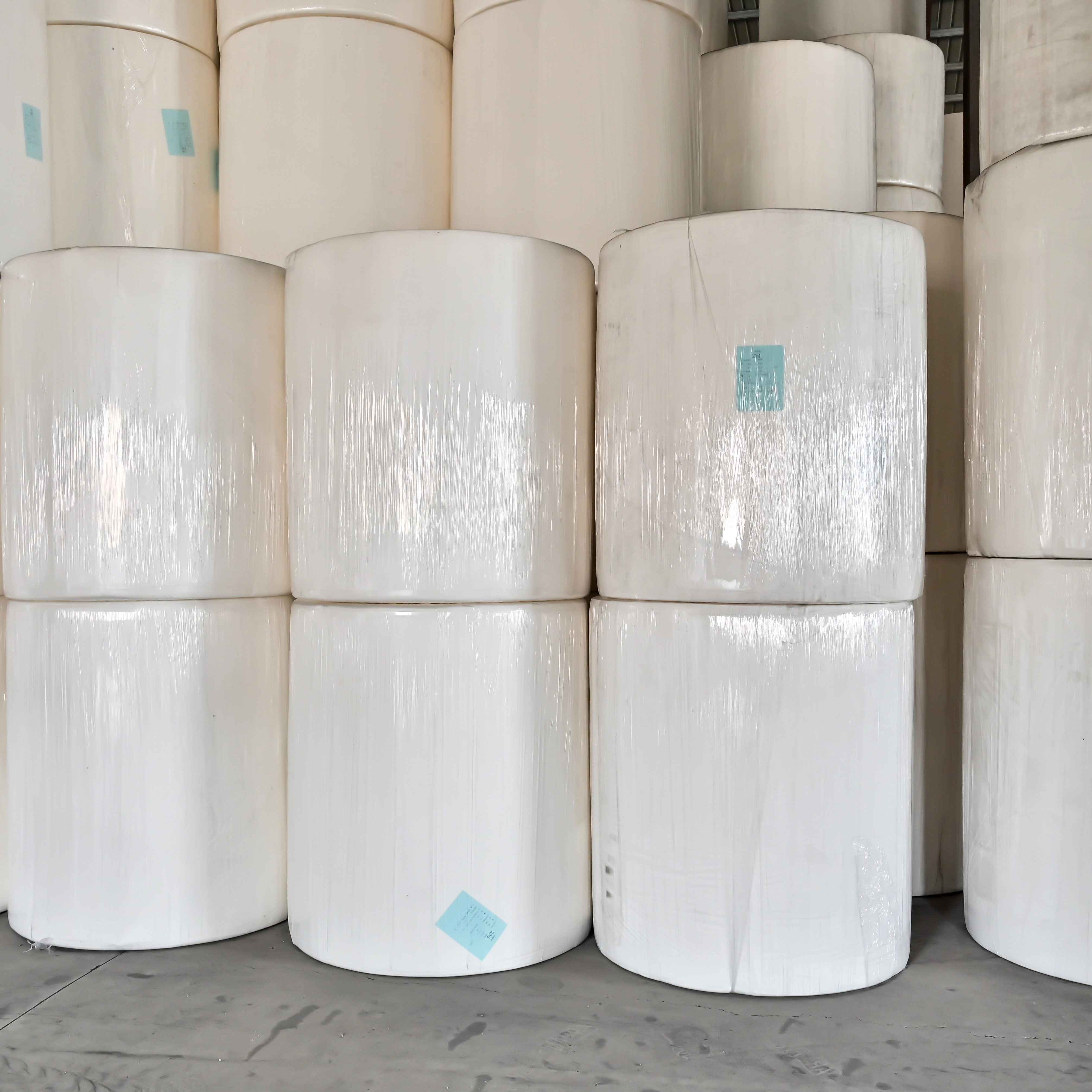
Parent rolls, also known as mother rolls, represent the raw material scale of the paper industry. Converters purchase these massive cylinders directly from paper mills. Engineers design the dimensions of these rolls to fit industrial rewinding and slitting machinery. Standard mill widths typically measure 565mm, 790mm, or 844mm. The continuous length of paper on a single parent roll ranges from 5,000 meters to 15,000 meters. This depends on the basis weight and the physical limitations of the shipping container.
Handling a parent Tissue Jumbo Roll requires specialized equipment. Operators use overhead cranes and heavy-duty clamp trucks to move them across the warehouse floor. The winding tension on these rolls must remain perfectly uniform. If the tension varies, the paper snaps during the high-speed converting process. Converters evaluate these rolls based on tensile strength, stretch percentage, and moisture content. This ensures the raw material withstands the mechanical stress of being unwound, perforated, and rewound into smaller commercial formats. Edge trim waste is also a major factor; converters must calculate exactly how many commercial rolls they can slit from a single parent roll without leaving unusable margins.
Commercial Jumbo Roll Tissue, commonly abbreviated as JRT, serves the Away-From-Home (AFH) market. These are the finished products installed in public restrooms, airports, stadiums, and office buildings. Unlike parent rolls, commercial JRT is categorized by capacity and outer diameter rather than a single exact meterage measurement. Distributors sell these rolls to facility managers who need to reduce restocking frequency in high-traffic environments.
The design philosophy behind commercial JRT focuses entirely on operational efficiency. A standard commercial roll holds the equivalent of up to ten standard residential toilet paper rolls. This high capacity directly reduces the labor hours required for janitorial staff to service a restroom. Maximizing capacity requires strict adherence to dimensional tolerances. The finished roll must fit perfectly inside wall-mounted dispenser housings. Manufacturers also apply a "tail tie" or light adhesive to the final sheet of the roll. This prevents the paper from unraveling inside the shipping carton during transit.
Evaluating commercial tissue requires a precise understanding of four primary specifications: width, outer diameter, core size, and basis weight. Each metric directly impacts hardware compatibility, user experience, and logistical efficiency.
Commercial jumbo toilet paper rolls are usually 3.7 to 4.5 inches (9.4 to 11.4 cm) wide. Narrower rolls may use less material, while wider rolls can provide a better user experience. However, the roll must fit correctly inside the dispenser. Buyers should measure the dispenser before ordering to prevent rubbing, tearing, or poor paper flow.
Roll diameter affects both tissue capacity and dispenser compatibility. Common commercial sizes include 9-inch and 12-inch rolls. A 9-inch roll may hold about 1,000 feet of 2-ply tissue or up to 2,000 feet of thinner 1-ply tissue. Buyers should check both diameter and ply count because rolls of the same size can contain different amounts of tissue.
Core size must match the dispenser spindle for the roll to work correctly. Standard 9-inch rolls often use a 3.30-inch core, while mini jumbo rolls commonly use a 2.30-inch core. Some dispensers use special core sizes or designs that only work with certain rolls. Buyers should check the spindle and core size before ordering to avoid compatibility problems.
GSM measures the paper’s density and helps indicate its thickness and strength. Many commercial jumbo rolls use about 15 GSM per ply. A standard 9-inch, 2-ply, 1,000-foot roll weighs about 1.70 lbs. Buyers can compare GSM, roll weight, and length to check paper quality and identify rolls that may be loosely wound or contain less tissue than expected.
The commercial JRT market segments products based on diameter and core size to accommodate different facility layouts and traffic volumes. Selecting the correct category requires balancing physical space constraints with maintenance schedules.
Mini jumbo rolls are about 7.40 inches in diameter and usually have a 2.30-inch core. They provide more tissue than standard residential rolls while requiring less space than larger jumbo rolls. This makes them suitable for medium-traffic facilities, compact restroom stalls, small retail stores, and restaurants where space is limited.
Standard 9-inch jumbo rolls usually measure 8.80 to 9.00 inches in diameter and use a 3.30-inch core. A typical 2-ply roll provides about 1,000 feet of tissue. This size is widely available and works with many standard commercial dispensers, making it a practical choice for most commercial restrooms.
12-inch jumbo rolls provide higher capacity and reduce how often staff need to replace rolls. They are suitable for busy locations such as airports, stadiums, and large industrial facilities. However, these rolls are larger and heavier, so they require strong dispensers and secure wall mounting. Facilities should check available space and wall support before using them.
Coreless jumbo rolls are tightly wound without a traditional cardboard core. This design reduces waste and allows more tissue to fit within the same roll size. They can help improve storage efficiency and reduce the number of empty cores that need disposal. However, coreless rolls require compatible dispensers and cannot be used on standard 3.30-inch spindles.
Category | Outer Diameter (OD) | Core Size (ID) | Typical Yield (2-Ply) | Best Use Case |
|---|---|---|---|---|
Mini Jumbo | ~7.40 inches | 2.30 inches | ~500 - 600 feet | Compact stalls, ADA compliance |
Standard 9-Inch | 8.80 - 9.00 inches | 3.30 inches | 1,000 feet | General commercial, universal compatibility |
12-Inch (Maxi) | ~12.00 inches | 3.30 inches | 2,000+ feet | Stadiums, airports, high-traffic |
Coreless | ~9.00 inches | None | 1,150+ feet | Zero-waste initiatives, high capacity in standard footprint |
Procuring tissue requires an evaluation framework that aligns physical product specifications with the operational realities of the facility. Hardware constraints, labor availability, and storage capacity must all influence the final purchasing decision.
Before buying jumbo rolls, check the dispenser size and spindle diameter. The roll’s outer diameter must fit inside the dispenser, while the core size must match the spindle. A core that is too small may stop the roll from turning smoothly, while a core that is too large may spin too freely and waste paper. Measuring the dispenser before ordering helps prevent these problems.
Choose roll capacity based on restroom traffic and how often staff need to replace rolls. Larger 12-inch rolls can reduce restocking time in busy facilities, but they also stay in the dispenser longer and may create more waste if damaged or contaminated. Standard 9-inch rolls may be more practical for locations with lower traffic. Businesses should balance labor savings, usage, and waste risks when choosing a roll size.
Jumbo roll size and winding quality can affect shipping and storage costs. Large cores and loosely wound rolls take up more space while providing less usable tissue. Tightly wound rolls can provide more paper within the same space, helping improve pallet and storage efficiency. Buyers should compare roll weight, GSM, and total length to understand how much usable tissue they receive.
Buyers frequently encounter pitfalls when transitioning between different tissue specifications. Misunderstanding how thickness, length, and packaging interact leads to budget overruns and inventory shortages.
Do not choose a jumbo roll based only on its diameter. A 9-inch 1-ply roll may contain about 2,000 feet of tissue, while a 9-inch 2-ply roll may contain about 1,000 feet. However, users often take more 1-ply tissue to get the same thickness as 2-ply. This means a longer 1-ply roll does not always reduce total tissue use or costs.
Commercial jumbo rolls may be measured by continuous feet or by the number of sheets. These measurements should be converted to the same unit before comparing prices. For example, 1,000 sheets at 4 inches each provide only about 333 feet of tissue. Buyers should compare the total length and cost per foot to understand the real value of each roll.
Jumbo roll cores can be damaged when pallets are stacked or handled poorly during transport. Even a slightly crushed core may prevent the roll from fitting correctly onto a dispenser spindle. Suppliers should use strong wrapping, edge protection, and clear stacking instructions to reduce this risk. Warehouse teams should also inspect rolls for core damage when shipments arrive.
Optimizing tissue jumbo roll sizes is an exercise in balancing dispenser constraints, labor costs for restocking, and freight efficiency. Relying on visual size or generic diameter measurements without verifying core compatibility and basis weight leads to operational failures and increased waste.
Advise your procurement team to audit current dispenser spindles before issuing Requests for Proposals (RFPs) for new tissue supplies. Measure the exact core inner diameter and the maximum housing outer diameter of every dispenser model currently installed in your facility.
Request detailed specification sheets from potential suppliers detailing GSM, core size, and guaranteed roll length.
Demand physical roll weight data to verify winding tension and paper density.
Normalize all vendor quotes into a strict cost-per-foot metric to eliminate discrepancies between 1-ply, 2-ply, and perforated formats.
Update vendor SLAs to include strict pallet-stacking rules to prevent core crushing during transit.
A: A standard commercial jumbo toilet paper roll typically ranges from 3.7 to 4.5 inches (9.4 to 11.4 cm) in width. In procurement and manufacturing documentation, this measurement is also frequently referred to as the roll height. Narrower widths reduce unit costs, while wider widths provide a better user experience but must fit within dispenser tolerances.
A: The primary difference is capacity and hardware requirements. A 9-inch roll is the industry standard, holding roughly 1,000 feet of 2-ply tissue. A 12-inch roll holds significantly more length, reducing restocking frequency for high-traffic areas like stadiums. However, it requires larger, specialized dispensers with reinforced wall mounting.
A: The 3.3-inch measurement refers to the inner diameter of the cardboard tube at the center of the roll. This core must perfectly match the dispenser's internal spindle. A 3.3-inch core is the universal standard for 9-inch commercial rolls, allowing the paper to unroll smoothly without causing spindle drag or free-spinning waste.
A: A standard 9-inch, 2-ply jumbo roll typically contains 1,000 continuous feet of tissue. If the roll is made of thinner 1-ply paper, it can contain up to 2,000 feet within the same 9-inch diameter. Some rolls are measured in perforated sheets, which requires calculating the sheet length to find the total footage.
A: Most commercial jumbo rolls utilize a 9# basis weight, translating to approximately 15 GSM (Grams per Square Meter) per ply. A standard 9-inch, 2-ply roll with 1,000 feet of paper should have a physical roll weight of approximately 1.70 lbs. Weight deviations often indicate loosely wound rolls or lower paper density.