close
Choose Your Site
Global
Social Media
Views: 0 Author: Site Editor Publish Time: 2026-07-01 Origin: Site
Table of Contents
Choosing the right facial tissue base paper is one of the most important decisions for tissue manufacturers and converters. While many buyers focus primarily on price, experienced producers understand that the quality of the base paper directly determines production efficiency, finished product performance, and long-term manufacturing costs.
A high-quality facial tissue jumbo roll does much more than simply provide raw material for converting. It influences machine stability, folding accuracy, dust generation, absorbency, softness, tensile strength, and even customer satisfaction. Poor-quality tissue base paper may appear less expensive initially, but it often leads to frequent web breaks, excessive paper dust, unstable embossing, inconsistent sheet dimensions, and increased machine downtime—all of which reduce productivity and increase operating costs.
As consumer expectations continue to rise, tissue manufacturers are under increasing pressure to produce softer, stronger, and more environmentally responsible facial tissues. Meeting these expectations begins with selecting the right facial tissue parent roll. Every stage of production—from slitting and rewinding to folding, interfolding, and packaging—depends on the consistency and performance of the base paper.
However, selecting tissue base paper involves much more than comparing GSM or roll width. Buyers must evaluate fiber quality, moisture content, roll hardness, tensile strength, dust performance, dimensional accuracy, and supplier reliability to ensure smooth production and consistent product quality.
This comprehensive guide explains everything tissue manufacturers need to know about choosing facial tissue base paper, including the most important technical specifications, common purchasing mistakes, quality evaluation methods, and practical tips for selecting a reliable supplier.
Whether you manufacture boxed facial tissues, soft-pack tissues, pocket tissues, or premium hospitality products, understanding these selection criteria will help you improve production efficiency, reduce waste, and deliver better products to your customers.
Premium facial tissue base paper is the essential raw material required for producing high-quality hygiene products.
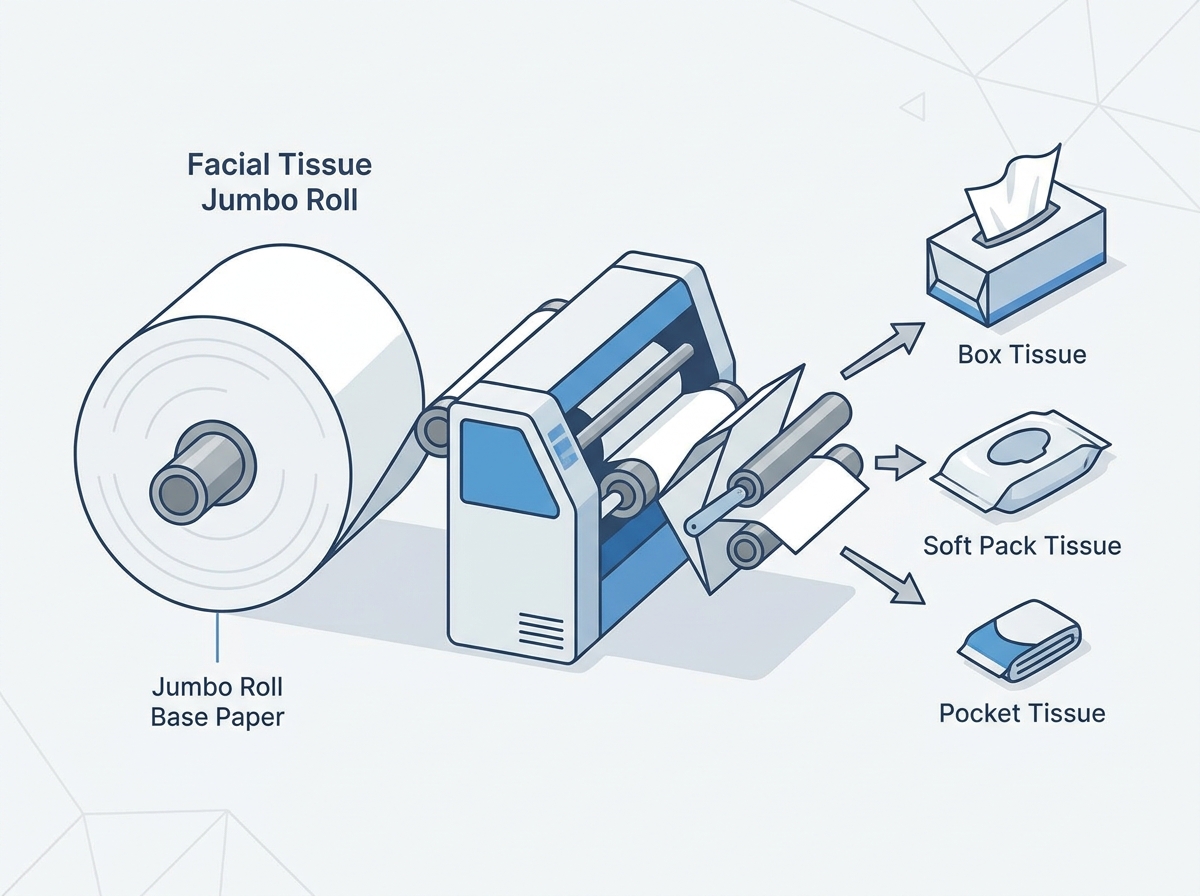
Facial tissue base paper, also known as facial tissue jumbo roll, facial tissue mother paper, or parent roll, is the large roll of tissue paper produced by paper mills before it is converted into finished facial tissue products. Rather than being sold directly to consumers, these jumbo rolls serve as the essential raw material used by tissue converters to manufacture a wide range of hygiene products.
During the converting process, the jumbo roll passes through several production stages, including slitting, embossing, laminating, rewinding, interfolding, cutting, counting, and packaging. The quality of the base paper determines how efficiently these operations run and ultimately affects the softness, appearance, absorbency, and durability of the finished tissue.
Unlike finished facial tissues, base paper has not yet been embossed, folded, scented, or packaged. It is designed to provide a stable, consistent foundation that allows converters to customize products according to market demands and brand requirements.
Although the two terms are often used interchangeably, tissue mother paper is a broader category that includes raw materials for multiple tissue products, while facial tissue base paper is specifically engineered for facial tissue manufacturing.
Facial tissue base paper typically places greater emphasis on:
Exceptional softness for sensitive skin
Low dust generation during converting
High brightness and clean appearance
Excellent absorbency
Stable tensile strength
Uniform sheet formation
Smooth interfolding performance
These characteristics ensure that finished facial tissues deliver the comfort and premium quality consumers expect.
Understanding the difference between base paper and finished tissue helps buyers choose the correct material for their production lines.
Facial Tissue Base Paper | Finished Facial Tissue |
|---|---|
Large jumbo roll | Individual consumer product |
Used by tissue converters | Ready for retail sale |
Requires converting processes | Fully processed and packaged |
Available in various GSM and widths | Available in different box or pack sizes |
Designed for manufacturing | Designed for end users |
The converting process transforms the parent roll into the products consumers use every day. As a result, any inconsistency in the base paper becomes magnified throughout production, making raw material quality one of the most critical factors in successful tissue manufacturing.
Because of its versatility, facial tissue base paper can be converted into numerous finished products for residential, commercial, and institutional markets.
Box facial tissues are among the most common applications. These products require excellent softness, smooth sheet separation, and reliable interfolding to ensure tissues dispense one at a time without tearing.
Pocket tissues require precise cutting and folding because of their compact size. Stable tensile strength and uniform thickness help prevent tearing during high-speed converting while maintaining portability and convenience.
Soft-pack tissues have become increasingly popular due to their lightweight packaging and reduced material consumption. High-quality base paper allows manufacturers to achieve excellent softness while maintaining sufficient strength for packaging and transportation.
Hotels, airlines, restaurants, and luxury commercial facilities demand premium facial tissues that offer outstanding softness, bright appearance, and consistent quality. Virgin wood pulp base paper is commonly selected to meet these higher customer expectations.
Medical facilities require facial tissue products that emphasize cleanliness, softness, and consistent quality. High-quality tissue base paper provides the reliable foundation necessary for producing hygienic disposable products used in hospitals, clinics, and healthcare environments.
Many tissue manufacturers assume that upgrading converting equipment alone will improve product quality. In reality, even the most advanced converting machines cannot compensate for poor-quality base paper. The performance of every facial tissue begins with the raw material.
Low-quality base paper often introduces problems long before the finished product reaches consumers. Weak fiber bonding can lead to web breaks during unwinding, while inconsistent GSM may cause uneven folding and sheet sizing. Excessive dust contaminates machinery, increases maintenance requirements, and reduces production efficiency. Poor moisture control can result in curling, wrinkles, or unstable roll tension, making high-speed converting more difficult.
By contrast, premium facial tissue base paper enables converters to achieve stable production, higher machine speeds, and more consistent finished products. Uniform fiber distribution improves embossing quality, while consistent tensile strength reduces unexpected machine stoppages. Better absorbency and softness also contribute to higher consumer satisfaction and stronger brand reputation.
The impact of base paper quality extends beyond manufacturing. It influences production costs, equipment utilization, product appearance, customer complaints, and long-term profitability. Investing in superior raw materials often delivers a lower total cost of ownership by reducing waste, minimizing downtime, and improving production efficiency.
The relationship between base paper quality and manufacturing performance can be summarized as follows:
High-Quality Base Paper
↓
Stable Unwinding Performance
↓
Fewer Web Breaks
↓
Lower Dust Generation
↓
Accurate Folding & Interfolding
↓
Consistent Product Quality
↓
Higher Production Efficiency
↓
Lower Manufacturing Costs
↓
Greater Customer Satisfaction
For professional tissue converters, selecting high-quality facial tissue base paper is not simply a purchasing decision—it is a strategic investment that supports reliable production, premium product quality, and sustainable business growth.
When purchasing facial tissue base paper, many buyers compare prices first. However, experienced tissue manufacturers understand that the lowest-priced jumbo roll is rarely the most economical choice. Hidden production costs caused by poor-quality base paper—such as machine downtime, excessive waste, dust accumulation, and customer complaints—often exceed the initial savings.
Instead of focusing solely on price, buyers should evaluate several technical and performance indicators that directly affect production efficiency and finished product quality.
The following table summarizes the most important evaluation criteria.
Evaluation Factor | Why It Matters |
|---|---|
Fiber Source | Determines softness, cleanliness, and absorbency. Virgin wood pulp provides superior performance. |
Fiber Length | Longer fibers improve tensile strength and reduce web breaks. |
GSM Consistency | Stable basis weight ensures uniform folding and minimizes material waste. |
Moisture Content | Proper moisture prevents curling, brittleness, and unstable roll tension. |
Dust Generation | Low dust keeps converting equipment cleaner and reduces maintenance. |
Roll Hardness | Uniform winding ensures smooth unwinding without deformation. |
Brightness | Bright white tissue improves product appearance and consumer perception. |
Formation Uniformity | Even fiber distribution improves softness and converting stability. |
Dimensional Accuracy | Consistent roll width and core size ensure machine compatibility. |
Supplier Stability | Reliable production capacity ensures long-term supply consistency. |
Although all these factors are important, three have the greatest influence on converting performance: fiber quality, GSM consistency, and tensile strength. These characteristics directly affect production speed, machine stability, and finished product quality.
Before placing a purchase order, professional tissue converters should verify the following items:
✅ Confirm whether the paper is produced from 100% virgin wood pulp
✅ Review the supplier's GSM tolerance report
✅ Request tensile strength test data
✅ Verify moisture content specifications
✅ Confirm roll width and core diameter compatibility
✅ Ask for dust performance test results
✅ Request production samples for machine trials
✅ Review quality certifications and inspection reports
Completing these checks before purchasing helps reduce production risks and ensures the selected base paper matches the requirements of your converting equipment.
The quality of facial tissue begins with the fibers used to manufacture the base paper. While modern papermaking technology has advanced significantly, no manufacturing process can fully compensate for poor-quality raw materials.
Premium facial tissue manufacturers typically choose 100% virgin wood pulp because it delivers superior softness, strength, absorbency, and cleanliness compared with recycled fibers.
However, not all virgin pulp is identical. Different wood species provide different performance characteristics.
Hardwood pulp is produced from fast-growing trees such as eucalyptus, birch, and poplar.
Because hardwood fibers are shorter and finer, they create tissue with:
Exceptional softness
Smooth surface texture
Higher bulk
Excellent absorbency
Better comfort for sensitive skin
This makes hardwood pulp the preferred choice for premium facial tissue.
Softwood pulp comes from pine, spruce, and fir trees.
Its fibers are significantly longer than hardwood fibers, providing:
Higher tensile strength
Better tear resistance
Improved converting stability
Stronger finished tissue
Better folding performance
Softwood fibers improve machine runnability, especially on high-speed converting lines.
Many premium manufacturers combine hardwood and softwood fibers to balance softness and strength.
A carefully engineered fiber blend allows manufacturers to produce tissue that feels soft while maintaining sufficient tensile strength for high-speed converting.
The exact ratio depends on product positioning and customer requirements.
Although recycled pulp offers cost advantages, it cannot match the overall performance of virgin fibers.
Feature | Virgin Wood Pulp | Recycled Fiber |
|---|---|---|
Softness | Excellent | Moderate |
Tensile Strength | Excellent | Lower |
Brightness | High | Medium |
Dust Generation | Low | Higher |
Fiber Uniformity | Excellent | Variable |
Hygiene | Better | Limited |
Food Contact Safety | Better | Limited |
Converting Performance | Stable | Less Consistent |
For manufacturers producing premium boxed tissues, hospitality tissues, or medical hygiene products, virgin wood pulp remains the preferred choice due to its consistent quality and superior converting performance.
Selecting the correct specifications is essential for ensuring smooth operation on converting equipment. Rather than simply choosing the thickest or widest paper available, manufacturers should select specifications that match their production requirements and target market.
GSM indicates the weight of tissue paper per square meter and influences softness, absorbency, thickness, and production cost.
Typical GSM recommendations include:
Application | Recommended GSM |
|---|---|
Facial Tissue | 13–17 gsm |
Premium Facial Tissue | 15–18 gsm |
Pocket Tissue | 13–16 gsm |
Soft Pack Tissue | 14–18 gsm |
Hotel Tissue | 15–20 gsm |
Selecting the appropriate GSM helps manufacturers achieve the right balance between softness, durability, and material efficiency.
Facial tissue base paper is commonly available in:
2-Ply
3-Ply
4-Ply
Additional plies increase softness, absorbency, and perceived product quality while also raising material costs.
Roll width should match the converting line to minimize edge trim waste.
Common widths include:
1650 mm
1750 mm
1800 mm
1850 mm
2770 mm
2800 mm
Many manufacturers also provide customized widths to maximize production efficiency.
Larger roll diameters reduce machine stoppages caused by roll replacement.
A standard roll diameter of approximately 1150 mm is commonly used for high-speed facial tissue converting.
The standard paper core diameter is typically 76 mm, ensuring compatibility with most modern tissue converting machines.
Professional manufacturers often provide customized:
GSM
Ply
Roll width
Roll diameter
Core size
Packaging
Roll weight
Customized specifications help converters optimize productivity while reducing raw material waste.
Many buyers focus only on the quality of the finished tissue, but experienced manufacturers understand that converting performance begins with the base paper.
Every production stage depends on the stability of the jumbo roll.
Consistent GSM and fiber formation produce clean edges with minimal dust generation.
Stable tensile strength prevents roll breaks and maintains uniform winding tension.
Uniform paper thickness produces sharper embossing patterns and stronger ply bonding.
Proper flexibility ensures accurate folding without wrinkles or cracking.
Premium facial tissue requires precise sheet separation. Uniform base paper allows tissues to dispense smoothly one sheet at a time.
Stable paper structure produces clean cuts with minimal burrs or loose fibers.
Low dust generation keeps sensors clean and reduces packaging defects on high-speed automatic lines.
The relationship between base paper quality and converting efficiency can be summarized as follows:
High-Quality Facial Tissue Base Paper
↓
Stable Slitting
↓
Smooth Rewinding
↓
Accurate Embossing
↓
Consistent Folding & Interfolding
↓
Clean Cutting
↓
Efficient Packaging
↓
Premium Finished Facial Tissue
A high-quality jumbo roll not only improves machine performance but also reduces downtime, lowers maintenance costs, and enhances the consistency of the final product.
Many tissue converters focus on machine performance when production issues occur. However, in many cases, the root cause lies in the quality of the facial tissue base paper rather than the converting equipment itself.
Poor-quality base paper can create a chain reaction throughout the entire production process, resulting in higher operating costs, reduced productivity, and inconsistent finished products. Understanding these common problems helps buyers identify potential risks before selecting a supplier.
Web breaks are one of the most common problems during facial tissue converting. Weak fiber bonding, inconsistent tensile strength, or poor moisture control can cause the paper web to tear while running at high speeds.
Every web break requires operators to stop the machine, rethread the paper, and restart production. This not only reduces production efficiency but also increases labor costs and raw material waste.
High-quality facial tissue base paper provides stable tensile strength and uniform fiber distribution, significantly reducing unexpected machine stoppages.
Paper dust is another major challenge in tissue converting.
Low-quality fibers tend to shed during slitting, embossing, folding, and cutting, producing excessive dust that accumulates on sensors, rollers, folding plates, and packaging equipment.
Excessive dust can lead to:
Increased machine cleaning frequency
Sensor malfunctions
Lower packaging efficiency
Higher maintenance costs
Reduced product cleanliness
Premium facial tissue base paper is engineered for low dust generation, helping manufacturers maintain cleaner production environments and longer machine operating times.
Facial tissues rely on precise folding and interfolding to ensure smooth sheet dispensing.
If the base paper has inconsistent GSM, poor flexibility, or unstable moisture content, tissues may:
Fold unevenly
Stick together
Misalign during interfolding
Tear when pulled from the box
These defects reduce consumer satisfaction and increase reject rates during production.
Improper roll hardness or uneven winding tension can cause wrinkles, telescoping, and edge damage during storage or converting.
Wrinkled paper often results in:
Poor embossing quality
Inaccurate cutting
Folding defects
Reduced production speed
Consistent roll hardness ensures smooth unwinding and stable web tension throughout the converting process.
Consumers judge facial tissues primarily by touch.
Low-quality base paper often feels rough, stiff, or overly dense due to poor fiber selection or excessive refining.
This negatively affects:
Skin comfort
Product quality perception
Brand reputation
Customer loyalty
Premium virgin wood pulp produces tissues with a softer hand feel and greater comfort during everyday use.
Variations in roll width, GSM, or paper thickness can result in inconsistent sheet dimensions after cutting and folding.
This may cause:
Uneven tissue stacks
Packaging defects
Customer complaints
Higher reject rates
Maintaining strict dimensional accuracy is essential for automated high-speed converting lines.
Many buyers assume cheaper raw materials reduce manufacturing costs. In reality, production efficiency often tells a different story.
Factor | High-Quality Base Paper | Low-Quality Base Paper |
|---|---|---|
Web Breaks | Rare | Frequent |
Dust Generation | Low | High |
Machine Downtime | Minimal | Significant |
Product Consistency | Excellent | Variable |
Waste Rate | Low | High |
Production Efficiency | High | Lower |
Total Manufacturing Cost | Lower Over Time | Higher Over Time |
Although premium tissue base paper has a higher purchase price, it often delivers a lower total production cost by improving machine efficiency and reducing waste.
Professional buyers understand that choosing facial tissue base paper requires more than reviewing a quotation. A thorough evaluation helps minimize production risks and ensures the material is compatible with existing converting equipment.
Before approving a supplier, buyers should assess the following key areas.
The first step is confirming whether the paper is manufactured from 100% virgin wood pulp, mixed pulp, or recycled fiber.
Virgin pulp generally provides:
Better softness
Higher absorbency
Greater tensile strength
Lower dust generation
Improved hygiene performance
Ask suppliers to clearly specify the fiber composition used in production.
Review whether the jumbo rolls meet your production requirements.
Key specifications include:
GSM
Ply configuration
Roll width
Roll diameter
Core diameter
Roll weight
Moisture content
Small variations in these parameters can significantly affect converting performance.
Reliable manufacturers should be able to provide laboratory data covering:
Tensile strength
Moisture content
Brightness
Basis weight (GSM)
Thickness (Caliper)
Bulk
Dust performance
These reports provide objective evidence of product quality before purchase.
Never place a large production order without testing samples on your own converting equipment.
Sample trials allow buyers to evaluate:
Machine speed
Dust generation
Folding quality
Web stability
Finished product softness
Overall production efficiency
Real production testing is often more valuable than laboratory data alone.
Long-term supply reliability is equally important.
Consider:
Production capacity
Factory scale
Export experience
Delivery performance
Quality management system
Customer service
A reliable supplier should be capable of maintaining consistent quality across every production batch.
Professional procurement teams often use a standardized checklist before placing bulk orders.
Inspection Item | Status |
|---|---|
Virgin wood pulp source verified | ✓ |
GSM within specification | ✓ |
Moisture content confirmed | ✓ |
Tensile strength tested | ✓ |
Brightness meets requirement | ✓ |
Dust generation evaluated | ✓ |
Roll hardness inspected | ✓ |
Roll width verified | ✓ |
Core diameter compatible | ✓ |
Sample production completed | ✓ |
Completing this checklist greatly reduces purchasing risks and improves long-term production stability.
High-quality facial tissue base paper serves as the foundation for numerous hygiene products across residential, commercial, healthcare, and hospitality industries.
Its versatility allows manufacturers to produce a wide variety of tissue products using the same parent roll with different converting processes.
Box facial tissues remain the largest application.
Consumers expect:
Ultra-soft texture
Excellent absorbency
Smooth sheet dispensing
Bright appearance
Strong yet gentle performance
Premium virgin wood pulp base paper is typically selected to meet these expectations.
Pocket tissues require compact folding and precise sheet dimensions.
Stable tensile strength helps prevent tearing during high-speed folding while maintaining excellent portability for consumers.
Soft-pack tissues have become increasingly popular because of their lightweight packaging and convenience.
High-quality base paper allows manufacturers to maintain softness while reducing packaging material and transportation costs.
Hotels, airlines, office buildings, and luxury commercial facilities demand premium tissue products that reflect their brand image.
High-brightness, low-dust, and soft-touch base paper helps manufacturers produce tissues that enhance the guest experience and maintain consistent quality standards.
Healthcare facilities require facial tissues with exceptional cleanliness, softness, and reliability.
Premium tissue base paper manufactured from virgin wood pulp provides excellent hygiene performance for hospitals, clinics, laboratories, and healthcare institutions.
Many international brands purchase facial tissue base paper for OEM or private-label production.
By selecting customized GSM, ply configuration, roll width, and packaging specifications, converters can manufacture products tailored to different regional markets and customer requirements.
Application | Primary Requirements |
|---|---|
Box Facial Tissue | Softness, absorbency, smooth dispensing |
Pocket Tissue | Precise folding, compact size |
Soft Pack Tissue | Softness, lightweight packaging |
Hotel Tissue | Premium appearance, consistency |
Medical Tissue | Hygiene, cleanliness, softness |
OEM Products | Flexible specifications and customization |
High-quality facial tissue base paper provides manufacturers with the flexibility to serve multiple market segments while maintaining consistent product quality and efficient converting performance.
Selecting the right facial tissue base paper is only part of the purchasing process. Equally important is choosing a manufacturer that can consistently deliver stable product quality, dependable lead times, and professional technical support.
A reliable supplier becomes a long-term production partner rather than simply a raw material vendor. The right manufacturer helps reduce operational risks, improve converting efficiency, and support sustainable business growth.
Before establishing a long-term partnership, buyers should evaluate suppliers across several critical areas.
Production capacity directly affects supply stability.
Manufacturers with modern paper machines and automated production lines are generally better equipped to maintain consistent quality while meeting large-volume orders.
Ask potential suppliers about:
Number of production lines
Monthly production capacity
Maximum roll width
Available GSM range
Export markets served
A supplier with sufficient capacity can better support seasonal demand fluctuations and long-term business expansion.
A professional manufacturer should implement strict quality control throughout every production stage.
Typical quality inspections include:
Raw material verification
Fiber consistency testing
Online GSM monitoring
Moisture control
Roll hardness inspection
Tensile strength testing
Brightness measurement
Final visual inspection
Factories operating under recognized quality management systems are more likely to deliver consistent products across multiple production batches.
Every converting factory has unique production requirements.
An experienced manufacturer should provide flexible customization services, including:
GSM customization
Roll width adjustment
Roll diameter options
Core diameter selection
Ply configuration
Packaging design
Private labeling
Customer-specific specifications
Customization reduces production waste and improves machine compatibility.
Many global distributors and tissue brands rely on OEM manufacturing.
A capable supplier should offer:
Private label production
Customized packaging
Brand printing
Export packaging solutions
Product specification customization
Strong OEM capabilities enable customers to build differentiated products while maintaining consistent quality.
Reliable delivery is essential for maintaining uninterrupted production.
When evaluating suppliers, buyers should consider:
Average production lead time
Export experience
Container loading efficiency
Logistics coordination
On-time delivery rate
Late deliveries may interrupt production schedules and increase inventory costs.
Professional tissue paper manufacturers should comply with applicable quality and environmental standards.
Depending on market requirements, buyers may request documentation related to:
Quality management systems
Sustainable sourcing
Product safety
Food-contact compliance (where applicable)
Environmental management
Well-documented suppliers provide greater purchasing confidence.
Excellent suppliers continue providing support after shipment.
Technical assistance may include:
Product recommendations
Machine compatibility advice
Specification optimization
Sample testing
Production troubleshooting
Continuous product improvement
Responsive technical support helps converters solve problems quickly and maximize production efficiency.
A structured evaluation system helps buyers compare multiple suppliers objectively.
Evaluation Factor | Importance |
|---|---|
Manufacturing Capacity | ⭐⭐⭐⭐⭐ |
Product Quality Consistency | ⭐⭐⭐⭐⭐ |
Virgin Fiber Quality | ⭐⭐⭐⭐⭐ |
Quality Control System | ⭐⭐⭐⭐⭐ |
Customization Capability | ⭐⭐⭐⭐☆ |
OEM Support | ⭐⭐⭐⭐☆ |
Delivery Reliability | ⭐⭐⭐⭐☆ |
Export Experience | ⭐⭐⭐⭐☆ |
Technical Support | ⭐⭐⭐⭐⭐ |
Overall Partnership Potential | ⭐⭐⭐⭐⭐ |
Rather than selecting suppliers based solely on price, evaluating these factors provides a more accurate picture of long-term value and production reliability.
Facial tissue base paper is a jumbo roll of tissue paper used as the raw material for manufacturing finished facial tissues. It is converted into boxed tissues, pocket tissues, soft-pack tissues, and other hygiene products through slitting, folding, embossing, cutting, and packaging.
Tissue mother paper is a general term covering raw materials for toilet paper, napkins, kitchen towels, and facial tissues. Facial tissue base paper is specifically designed for facial tissue production and typically emphasizes greater softness, lower dust generation, and superior sheet formation.
Virgin wood pulp provides longer fibers, better softness, higher tensile strength, improved brightness, lower dust generation, and better hygiene performance than recycled fibers. These advantages contribute to higher-quality facial tissue products and more stable converting performance.
Most facial tissue products use base paper between 13 and 17 gsm, while premium tissues may use 15–18 gsm depending on softness and strength requirements.
Common causes include low tensile strength, inconsistent GSM, poor fiber bonding, improper moisture content, and unstable roll hardness. High-quality base paper significantly reduces web breaks during high-speed production.
Selecting premium facial tissue base paper manufactured from virgin wood pulp with strong fiber bonding helps minimize dust generation. Regular machine maintenance and optimized slitting conditions also contribute to cleaner production.
Professional buyers typically review:
Fiber source
GSM consistency
Moisture content
Tensile strength
Roll hardness
Brightness
Roll dimensions
Laboratory test reports
Sample production results
These evaluations help ensure compatibility with converting equipment and stable production quality.
Yes. Most professional manufacturers provide customized GSM, roll width, roll diameter, core size, ply configuration, packaging, and OEM branding services to meet specific production requirements.
Jumbo rolls should be stored in a clean, dry, well-ventilated warehouse away from direct sunlight and excessive humidity. Proper storage helps maintain moisture balance, prevent roll deformation, and preserve paper quality before converting.
Choose suppliers with stable manufacturing capacity, consistent product quality, advanced production equipment, flexible customization options, comprehensive quality control, reliable delivery performance, and responsive technical support. Long-term partnerships with experienced manufacturers typically provide better value than selecting suppliers based on price alone.
Choosing the right facial tissue base paper is not simply about purchasing a raw material—it is about building a stable and efficient production process.
From fiber selection and GSM consistency to roll hardness and converting performance, every characteristic of the base paper influences the quality of the finished facial tissue. Premium raw materials help reduce machine downtime, minimize waste, improve product consistency, and strengthen customer satisfaction.
Equally important is selecting a reliable manufacturing partner. A supplier with advanced production technology, strict quality control, flexible customization, and dependable technical support can provide lasting value beyond competitive pricing.
As global demand for premium hygiene products continues to grow, investing in high-quality facial tissue base paper allows manufacturers to improve production efficiency, deliver superior products, and remain competitive in an increasingly demanding market.