close
Choose Your Site
Global
Social Media
Views: 0 Author: Site Editor Publish Time: 2026-07-17 Origin: Site
Table of Contents
Most buyers assume that soft tissue paper automatically means high quality. In reality, softness is only one part of the equation. The overall performance of tissue products depends on fiber quality, manufacturing technology, moisture control, creping precision, and the consistency of every jumbo roll.
For tissue converters, poor-quality tissue mother paper can lead to frequent web breaks, excessive dust, unstable embossing, and costly production downtime. Choosing the right raw material is therefore one of the most important decisions for maintaining product quality and manufacturing efficiency.
This guide explains how tissue mother paper is manufactured, what technical specifications buyers should evaluate, and how to select reliable tissue jumbo roll suppliers for long-term production success.
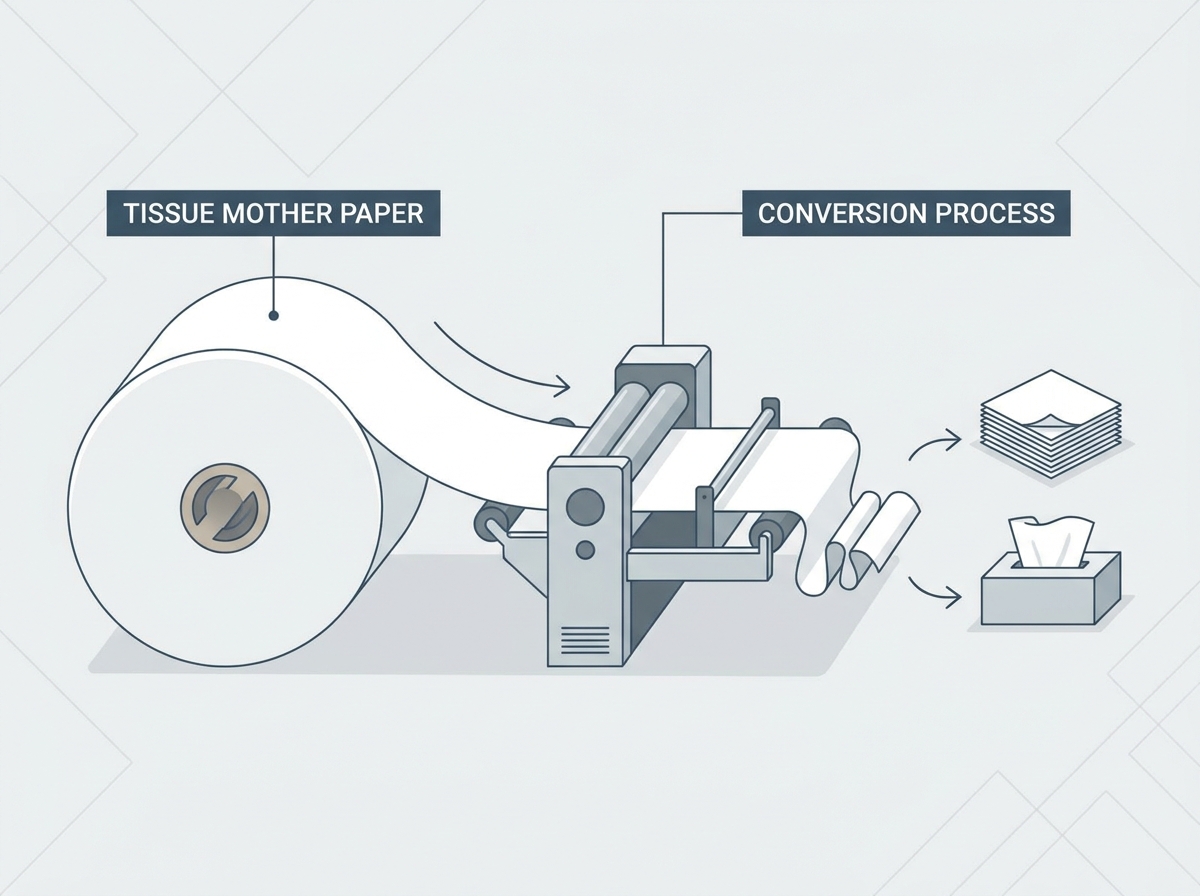
High-quality tissue raw materials prepared for the conversion process.
Tissue mother paper, also known as tissue jumbo roll, parent roll, or mother roll, is the large roll of base paper used to manufacture finished tissue products such as toilet paper, facial tissues, kitchen towels, napkins, and industrial wipes. Instead of being sold directly to consumers, tissue mother paper serves as the primary raw material for tissue converters, who transform these jumbo rolls into retail-ready products through processes such as embossing, laminating, perforating, folding, cutting, and packaging.
The quality of tissue mother paper has a direct impact on the performance of every finished product. Factors such as softness, absorbency, tensile strength, brightness, dust level, and runnability on high-speed converting machines all originate from the manufacturing quality of the mother roll. Even the most advanced converting equipment cannot compensate for poor-quality base paper.
High-quality tissue mother paper is typically manufactured from 100% virgin wood pulp or carefully selected fiber blends. During production, manufacturers precisely control fiber refining, sheet formation, moisture content, drying, and creping to achieve a balance between softness, bulk, strength, and absorbency. These characteristics ensure stable production with fewer web breaks, less dust generation, and higher converting efficiency.
Depending on the intended application, tissue mother paper is available in different GSM (grams per square meter), ply configurations, roll widths, diameters, and core sizes. Converters can choose specifications that best match their production equipment and target markets, whether they manufacture premium facial tissues, cost-effective toilet paper, heavy-duty kitchen towels, or high-end catering napkins.
For manufacturers, purchasing high-quality tissue mother paper is more than simply buying paper rolls—it is an investment in production efficiency, product consistency, and customer satisfaction. Selecting the right supplier helps reduce material waste, minimize machine downtime, improve finished product quality, and lower long-term operating costs.
High-quality tissue mother paper is widely converted into:
Toilet Paper – Soft and durable rolls for residential and commercial use.
Facial Tissue – Premium tissues with excellent softness and absorbency.
Kitchen Towels – Strong and highly absorbent paper for household and food-service cleaning.
Paper Napkins – Available in various ply and GSM options for restaurants, hotels, and catering services.
Industrial Wipes – High-strength tissue products designed for manufacturing, maintenance, and cleaning applications.
Medical and Hygiene Tissue Products – Specialized tissue materials used in healthcare and sanitary environments.
Buyer Tip: When evaluating tissue mother paper, don't focus on price alone. Compare the fiber source, GSM consistency, tensile strength, moisture content, roll hardness, and machine compatibility. A higher-quality mother roll often reduces production downtime, minimizes waste, and delivers better finished products, resulting in a lower total manufacturing cost over time.
The production of high-quality tissue mother paper is a carefully controlled manufacturing process that combines advanced papermaking technology with strict quality management. Every production stage—from fiber selection to final inspection—directly affects the softness, absorbency, strength, and converting performance of the finished tissue products.
Modern tissue paper manufacturers use highly automated production lines to ensure every jumbo roll delivers consistent quality, allowing converters to achieve stable operation, minimize waste, and produce premium tissue products efficiently.
Everything begins with selecting the right raw materials. The quality of the fibers determines nearly every performance characteristic of tissue mother paper, including softness, tensile strength, absorbency, brightness, and durability.
Most premium tissue manufacturers use 100% virgin wood pulp, which contains longer, cleaner, and more uniform fibers than recycled materials. Virgin pulp produces smoother paper surfaces, better fiber bonding, and fewer contaminants, making it the preferred choice for high-end tissue products.
Virgin pulp generally comes from two primary sources:
Hardwood pulp is produced from trees such as eucalyptus, birch, and poplar. These fibers are shorter and finer, allowing manufacturers to create tissue paper with exceptional softness, smoothness, and bulk. Hardwood fibers are widely used in facial tissues, napkins, and premium toilet paper where comfort is a priority.
Softwood pulp is obtained from pine, spruce, and fir trees. These fibers are considerably longer than hardwood fibers, providing higher tensile strength and better tear resistance. Softwood pulp helps tissue maintain stability during high-speed converting while improving durability during consumer use.
Although recycled fiber can reduce raw material costs, it generally contains shorter fibers, residual impurities, and lower strength due to repeated recycling cycles. Virgin wood pulp provides significant advantages, including:
Higher softness and absorbency
Better brightness and cleanliness
Lower dust generation during converting
Greater tensile strength
Improved machine runnability
Better food-contact and hygiene performance
For manufacturers targeting premium consumer products or hospitality markets, virgin wood pulp remains the preferred raw material.
After the raw fibers are selected, they are mixed with large volumes of water to create a fiber suspension known as pulp slurry. At this stage, careful process control is essential to ensure uniform fiber distribution before paper formation begins.
Mechanical refiners gently separate and fibrillate the fibers, increasing their surface area and improving fiber bonding. Proper refining enhances sheet strength while maintaining the softness required for tissue products.
Over-refining can make tissue dense and stiff, while under-refining may result in weak paper with poor converting performance. Manufacturers therefore optimize refining intensity according to the target product specifications.
Water plays a critical role throughout papermaking. During pulp preparation, fiber concentration typically remains below 1%, meaning the mixture consists primarily of water. Maintaining the correct water-to-fiber ratio ensures even fiber dispersion, prevents fiber clumping, and supports uniform sheet formation.
Advanced control systems continuously monitor pulp consistency to maintain stable production conditions.
Small amounts of specialty chemicals may be added during this stage to improve paper performance. Depending on product requirements, manufacturers may use:
Wet strength agents
Dry strength additives
Retention aids
Defoamers
pH control chemicals
These additives help optimize strength, drainage efficiency, fiber retention, and machine productivity while maintaining product safety and quality.
Once the pulp slurry is fully prepared, it enters the tissue paper machine where the paper sheet begins to take shape.
The diluted fiber suspension is evenly distributed across a rapidly moving forming wire. Modern tissue machines operate at extremely high speeds while maintaining precise control over fiber orientation and sheet consistency.
As water drains through the forming fabric, individual fibers interlock to create a continuous paper web. Uniform fiber distribution is essential because it directly affects tissue strength, softness, appearance, and converting performance.
Poor sheet formation often results in weak spots, uneven thickness, or inconsistent product quality.
Efficient drainage removes most of the water from the paper web before drying. Vacuum systems and gravity work together to rapidly extract moisture while preserving fiber structure.
Proper drainage improves machine efficiency and reduces energy consumption during drying.
High-quality tissue mother paper must maintain excellent uniformity across the entire roll. Consistent basis weight (GSM), thickness, moisture distribution, and fiber formation ensure stable performance during embossing, laminating, rewinding, and cutting operations.
Uniform paper also reduces web breaks and improves finished product consistency.
The drying and creping process is widely recognized as the most important stage in tissue paper manufacturing because it largely determines the final softness, bulk, and absorbency of the product.
The partially dried paper web is transferred onto a massive steam-heated steel cylinder known as the Yankee Dryer. This cylinder rapidly removes the remaining moisture while carefully controlling paper drying conditions.
Modern Yankee dryers can exceed five meters in diameter and operate under precisely regulated temperatures to achieve consistent drying performance.
After drying, a specialized Creping Doctor Blade scrapes the paper from the Yankee surface.
This controlled scraping action creates thousands of microscopic folds across the paper surface—a process known as creping.
Creping introduces micro-folds that increase the flexibility of the paper sheet. These tiny folds reduce stiffness and create the soft texture consumers expect from premium tissue products.
The quality of the creping process has a direct influence on hand feel, comfort, and overall product quality.
Besides improving softness, creping also increases paper bulk by expanding the paper structure. Higher bulk creates more air pockets within the sheet, improving absorbency while giving tissue a thicker and more luxurious appearance without significantly increasing material usage.
After drying, the finished tissue web is wound into large tissue mother rolls, also known as jumbo rolls, ready for shipment to tissue converters.
Large jumbo rolls reduce the frequency of roll changes during converting operations, minimizing production interruptions and improving manufacturing efficiency. Roll diameters are selected according to customer requirements and converting equipment.
The paper is wound onto a paper core with standardized dimensions, typically 76 mm or other customized sizes. Selecting the correct core diameter ensures compatibility with unwinding systems on converting machines.
Roll hardness is carefully controlled during winding. Excessively soft rolls may deform during transportation, while overly hard rolls can create tension problems during unwinding.
Modern winding systems automatically monitor roll density and tension to produce stable, uniform jumbo rolls that perform reliably on high-speed converting lines.
Before shipment, every tissue mother roll undergoes comprehensive quality inspection to ensure it meets customer specifications and production standards.
Manufacturers typically evaluate several critical quality indicators.
Maintaining the correct moisture content helps preserve softness while preventing curling, brittleness, or web breaks during converting.
Low dust generation is essential for maintaining clean converting equipment and reducing machine maintenance. Premium tissue paper produces significantly less paper dust during unwinding and embossing.
Laboratory testing verifies both dry and wet tensile strength to ensure the paper can withstand high-speed processing without tearing.
Each roll is measured to confirm basis weight (GSM) and caliper remain within specified tolerances, ensuring consistent product quality throughout the entire roll.
Finished roll weight is carefully checked to verify production accuracy and optimize transportation efficiency.
Finally, experienced quality inspectors examine every jumbo roll for defects such as wrinkles, holes, edge damage, contamination, uneven winding, color variation, or surface imperfections before the rolls are packaged and prepared for shipment.
Only after passing these inspections is the tissue mother paper approved for delivery, ensuring converters receive reliable raw materials that support stable production, high converting efficiency, and consistent finished product quality.
Not all tissue mother paper delivers the same performance. While many products may appear similar in terms of thickness or color, their actual converting efficiency and finished product quality can vary significantly. High-quality tissue mother paper is defined by a combination of carefully controlled technical specifications rather than a single characteristic.
For tissue converters, evaluating these quality factors before purchasing helps reduce production downtime, improve finished product consistency, and lower overall manufacturing costs.
Quality Factor | Why It Matters |
|---|---|
Virgin Wood Pulp | Produces superior softness, absorbency, and cleanliness compared with recycled fibers. |
Fiber Length | Longer fibers improve tensile strength and reduce web breaks during converting. |
Moisture Control | Proper moisture content ensures stable unwinding and minimizes curling or brittleness. |
GSM Consistency | Uniform basis weight reduces material waste and improves converting efficiency. |
Roll Hardness | Proper winding tension allows smooth unwinding without deformation or telescoping. |
Tensile Strength | Higher strength prevents tearing during embossing, perforating, and rewinding. |
Brightness | A brighter, cleaner appearance enhances the quality perception of finished tissue products. |
Dust Level | Low dust generation keeps converting equipment cleaner and reduces maintenance frequency. |
A premium tissue mother roll should deliver consistent quality from the beginning to the end of every roll. Stable specifications not only improve production efficiency but also ensure converters can manufacture tissue products with reliable softness, strength, and appearance.
Selecting the correct tissue jumbo roll specification is essential for maximizing converting efficiency and producing tissue products that meet market requirements. Tissue manufacturers typically offer a variety of specifications to accommodate different converting machines, production capacities, and end-use applications.
GSM indicates the weight of tissue paper per square meter and is one of the most important specifications buyers evaluate.
Lower GSM grades (13–17 gsm) are commonly used for facial tissues and lightweight napkins, while higher GSM grades (20–40 gsm) provide greater strength and absorbency for kitchen towels, industrial wipes, and premium catering products.
Choosing the appropriate GSM helps balance production cost, product performance, and customer expectations.
Tissue mother paper is available in multiple ply configurations, including:
2-Ply
3-Ply
4-Ply
Additional plies increase thickness, softness, absorbency, and overall strength. Premium consumer products often utilize three or four layers for improved comfort and durability.
Roll width determines compatibility with converting equipment and directly affects production efficiency.
Common widths include:
1650 mm
1750 mm
1800 mm
1850 mm
2770 mm
2800 mm
Many manufacturers also provide customized widths to minimize trim waste and maximize material utilization.
The standard core diameter is typically 76 mm, although customized core sizes are available for specialized converting machinery.
Selecting the proper core size ensures smooth installation and stable unwinding during production.
Large jumbo rolls reduce machine stoppages caused by frequent roll replacement.
A typical roll diameter is around 1150 mm, allowing converters to improve productivity while reducing labor costs and downtime.
Reliable manufacturers can customize tissue jumbo rolls according to customer requirements, including:
GSM
Ply
Roll width
Roll diameter
Core size
Roll weight
Packaging method
Customized specifications allow converters to optimize production efficiency while meeting different market demands.
One of the first questions buyers should ask when sourcing tissue mother paper is whether the material is produced from virgin wood pulp or recycled fiber. While both options have their place in the market, they offer significantly different performance characteristics.
Virgin wood pulp consists of fresh fibers harvested directly from sustainably managed forests. These fibers are longer, cleaner, and stronger, making them ideal for premium tissue products. Recycled pulp, on the other hand, has undergone multiple processing cycles, resulting in shorter fibers and reduced strength.
The following comparison highlights the key differences:
Feature | Virgin Wood Pulp | Recycled Pulp |
|---|---|---|
Softness | Excellent | Moderate |
Strength | Excellent | Lower |
Brightness | High | Medium |
Dust Generation | Low | Higher |
Food Contact Safety | Better | Limited |
Absorbency | Excellent | Moderate |
Fiber Uniformity | Excellent | Variable |
Converting Performance | Stable | Less Consistent |
For manufacturers producing premium facial tissues, hotel napkins, kitchen towels, or food-contact products, virgin wood pulp remains the preferred choice due to its superior quality and converting stability.
Using low-quality tissue mother paper may reduce raw material costs initially, but it often leads to significant production losses during converting. Poor fiber quality and inconsistent manufacturing can negatively impact machine performance, finished product quality, and overall operating efficiency.
Weak paper with low tensile strength is more likely to tear during high-speed unwinding, embossing, or rewinding. Frequent web breaks increase downtime and reduce production output.
Low-quality tissue often generates excessive dust during converting. Paper dust contaminates machinery, increases maintenance requirements, shortens equipment life, and affects product cleanliness.
Inconsistent paper thickness or weak fiber bonding can prevent embossing patterns from forming clearly. Finished products may appear uneven or lose their decorative texture.
Improper roll hardness or inconsistent winding tension can result in wrinkles, telescoping, edge damage, or unstable unwinding during production.
Inferior fiber quality reduces the paper's ability to absorb liquids efficiently, resulting in lower-performing tissue products that fail to meet customer expectations.
Poor winding quality or incorrect moisture content may cause jumbo rolls to become oval-shaped or compressed during transportation and storage, creating difficulties during machine loading.
Although lower-grade tissue may appear less expensive, these hidden production losses often result in a much higher total manufacturing cost.
Professional tissue converters rarely make purchasing decisions based on price alone. Instead, they evaluate multiple technical specifications to ensure the raw material meets production requirements and quality expectations.
Before placing an order, buyers should verify the following checklist:
Inspection Item | Check |
|---|---|
Virgin wood pulp source | ✓ |
GSM tolerance | ✓ |
Moisture content | ✓ |
Tensile strength report | ✓ |
Roll hardness consistency | ✓ |
Width tolerance | ✓ |
Core size compatibility | ✓ |
Sample roll testing | ✓ |
In addition to reviewing technical specifications, buyers should also request laboratory reports, product samples, and production videos whenever possible. Testing sample rolls on actual converting equipment is one of the most effective ways to evaluate product performance before committing to large-volume purchases.
Tissue jumbo rolls serve as the foundation for a wide range of consumer and commercial hygiene products. By selecting different GSM values, ply structures, and converting processes, manufacturers can produce tissue products tailored to specific industries and customer needs.
Widely used in restaurants, hotels, catering companies, cafés, and fast-food chains. Premium napkins require excellent softness, embossing quality, and absorbency.
Designed for superior liquid absorption and wet strength, kitchen towels are commonly used in households, commercial kitchens, and food processing facilities.
One of the largest applications of tissue mother paper. Product quality depends on softness, tensile strength, bulk, and consistent perforation during converting.
Luxury hotels require tissue products with high brightness, premium softness, and consistent quality to enhance guest experience and reinforce brand standards.
Industrial tissue products require higher GSM and superior strength to handle oil, grease, solvents, and heavy-duty cleaning applications.
Premium facial tissues emphasize softness, low dust generation, skin comfort, and high absorbency, making high-quality virgin wood pulp essential.
Selecting the right supplier is just as important as choosing the right product. A reliable tissue mother paper manufacturer provides not only high-quality raw materials but also consistent production, dependable delivery, and long-term technical support.
Choose manufacturers with modern production lines and sufficient capacity to ensure stable supply for long-term cooperation and growing order volumes.
Reliable suppliers implement strict quality management throughout the manufacturing process, including raw material inspection, online monitoring, laboratory testing, and final product verification.
Every converter has different production requirements. A professional manufacturer should offer customized GSM, ply options, roll width, diameter, core size, packaging, and labeling services.
For brand owners and international distributors, OEM services provide customized specifications, packaging solutions, and branding support that help differentiate products in competitive markets.
Timely delivery is critical for maintaining production schedules. Manufacturers with efficient logistics management and export experience can help minimize supply chain disruptions.
Look for suppliers that comply with internationally recognized quality management standards and can provide documentation related to product quality, food-contact safety, and sustainable manufacturing practices when required.
A reliable supplier acts as a long-term production partner rather than simply a material vendor. Experienced technical teams can recommend suitable specifications, troubleshoot converting issues, optimize raw material selection, and support continuous production improvement.
Ultimately, the best tissue mother paper manufacturer is one that consistently delivers high-quality products, responsive customer service, flexible customization, and dependable technical expertise—helping converters improve efficiency, reduce waste, and produce premium tissue products that stand out in the marketplace.
Tissue mother paper, also known as a tissue jumbo roll or parent roll, is the large base roll used to manufacture finished tissue products such as toilet paper, facial tissues, kitchen towels, napkins, and industrial wipes. It is produced in paper mills and later converted into consumer-ready products through embossing, perforating, cutting, folding, and packaging.
Tissue mother paper is the raw material used by tissue converters, while finished tissue paper is the final consumer product. A jumbo roll must go through several converting processes before becoming toilet paper rolls, facial tissues, napkins, or kitchen towels.
Virgin wood pulp contains longer and cleaner fibers than recycled pulp, resulting in better softness, absorbency, tensile strength, and brightness. It also generates less paper dust during converting, making it the preferred choice for premium tissue products and food-contact applications.
The appropriate GSM depends on the final application.
13–15 gsm: Facial tissues
15–18 gsm: Toilet paper
18–25 gsm: Napkins
20–30 gsm: Kitchen towels
25–40 gsm: Industrial wipes
Choosing the correct GSM helps balance softness, strength, absorbency, and production costs.
The manufacturing process typically includes:
Virgin wood pulp selection
Pulp preparation and refining
Sheet forming
Yankee drying and creping
Jumbo roll winding
Quality inspection and packaging
Each stage contributes to the final paper's softness, strength, absorbency, and converting performance.
Frequent web breaks are usually caused by poor-quality tissue mother paper with inconsistent GSM, weak tensile strength, uneven moisture distribution, or improper roll hardness. Using high-quality jumbo rolls helps maintain stable converting operations and reduce downtime.
Professional buyers typically evaluate several technical specifications, including:
Fiber source (Virgin or Recycled)
GSM consistency
Moisture content
Tensile strength
Roll hardness
Roll width and diameter
Core size compatibility
Product samples and laboratory reports
Testing sample rolls on converting equipment before bulk purchasing is highly recommended.
Tissue jumbo rolls are widely used in manufacturing:
Toilet paper
Facial tissues
Paper napkins
Kitchen towels
Hotel tissue products
Industrial wipes
Medical and hygiene paper products
Different applications require different GSM values, ply configurations, and converting processes.
Tissue jumbo rolls should be stored in a clean, dry warehouse away from moisture, dust, and direct sunlight. Maintaining stable temperature and humidity helps preserve paper quality, prevents roll deformation, and ensures consistent converting performance.
When selecting a supplier, buyers should consider several key factors:
Use of 100% virgin wood pulp
Stable product quality and GSM consistency
Modern production equipment
Strict quality control system
Customization capabilities
OEM and private label services
On-time delivery
Technical support and after-sales service
A reliable manufacturer not only supplies high-quality tissue mother paper but also helps improve converting efficiency, reduce production waste, and support long-term business growth.